Hi...
Now i m going to say one top most secreat that how to generate more traffic to webpages or blogs.
Do Register on fun traffic system use below link,
http://www.funender.com/free_traffic/signup-3309.html
They provide free point with intially. Based on that free points you get free traffic to your website or blogs.
Enjoy!!!!!
Tuesday, October 6, 2009

Tuesday, September 1, 2009
Best of the tutorials - u3schools - html,php,sql,ajax and dom
u3schools is the best of the tutorial websites over the internet.
u3schools will teach you step by step process with simple examples.
while we are work with this examples we reach full knowledge about that particular web development language.
u3schools provide currently html,php,sql,ajax and dom.
Visit u3 schools: http://u3schools.com
Hope this infomation helpfull for you. Please write your valuable comments below this post.
u3schools will teach you step by step process with simple examples.
while we are work with this examples we reach full knowledge about that particular web development language.
u3schools provide currently html,php,sql,ajax and dom.
Visit u3 schools: http://u3schools.com
Hope this infomation helpfull for you. Please write your valuable comments below this post.
Tuesday, March 10, 2009
Tips to get the best results
Vote Early, Vote Often
Are you tired of sitting quietly in the background, but lack the boldness to post your opinion? SitePoint Forums' polls let you discreetly join the conversation. They enable you to follow the ever-changing Internet trends and give you a chance to influence them. So vote early and vote often! We've compiled a list of currently open polls to start with:
- Promotion Techniques
> If you had to choose one Autoresponder which would it be?
- MySQL
- Search Engine Optimization
- Business and Legal Issues
- .NET
> If you've tested or started using IE8RC1 moving from IE7, how has it worked?
- General Chat
- Web Page Design
- Content
- Blogging
> Is your web site merged with your blog, or is your blog in a subdirectory?
- Graphics
The polls below recently closed, but you can click on the links for the results:
- Business and Legal Issues
- General Chat
It's easy to start your own poll, too. Post your thread as usual but before you submit, scroll down and click on “Add a Poll.” Then submit your thread and you'll be redirected to your poll. There you can enter your questions or change any options.
latest and greatest in SitePoint
Simply SQL -- a practical, step-by-step guide to writing SQL.
Rather than bore you with theory, in Simply SQL author Rudy Limeback focuses on the practical use of SQL with common databases. It's packed with plenty of diagrams, easy-to-read text, and clear examples to help make learning SQL easy and fun.
Any questions? Rudy (aka r937) is always around the forums -- almost 24/7 -- to answer them.
The Official SitePoint Twitter Background Competition
Around my neighborhood spring is in the air. The birds are a-twitter and so is nearly everyone else!
If you have imagination, creativity, and style, this contest is for you. Design the best Twitter profile background imaginable and submit it in any graphic format that Photoshop can open. (Just remember, you'll be sending it by email so make it a reasonable size!)
Contest ends March 26, 2009. Our judges will consider any theme or style except for those that include political, violent, or adult references. Nothing controversial or offensive, please. Complete contest and entry submission details available here.
Prizes go to the top 10 entries: your choice of The Principles of Beautiful Design by Jason Beaird or a copy of the soon-to-be-released Sexy Web Design by Elliot Jay Stocks.
Need inspiration? Read Mihaela Lica's blog post, Beautiful Twitter Backgrounds to Inspire You for the SitePoint Twitter Contest.
SitePoint at SxSW Interactive 2009
SitePoint will be represented at SxSWi in Austin, Texas, March 13-17.
Besides co-founder, Matt Mickiewicz and some Australian staff members, it's your chance to meet SitePoint authors like Jason Beaird, Jina Bolton and Josh Catone, plus SitePoint Forum staff members like Podcast co-host Patrick O'Keefe and forum advisor Brandon Eley. You’ll find them all at the Razorfish opening party at The Madison, starting at 6pm on March 14.
Please post if you'll be attending. As Matt mentioned, we’d love to meet everyone in person.
Server-side JavaScript Common as PHP
Reading through the comments on Craig Buckler's blog post,
It also confirms another fact: a lot of people hate JavaScript. I'm confident though -- for programmers who appreciate JavaScript's finer features and can accept its rougher parts -- that the news JavaScript is moving server-side is unsurprising and probably welcome. And I'm certain that this is only the beginning.
So where can JavaScript be found server-side right now?
Jaxer is a JavaScript web application framework and server. The server-side API is as capable as any, including access to databases, files, and network sockets. There's a blurring of the boundary between server-side and client-side scripting; for example, server-side scripts can manipulate the web page DOM.
Scripts are embedded ASP style into your HTML:
The runat attribute can be server, both, or server-proxy. If set to server, the script is evaluated before the page is sent to the browser. If not set the scripts are executed client-side. If set to server-proxy, then the functions can be called from a client-side script by name, but are proxied, via Ajax, to the server-side equivalent.
Helma is another web application framework that uses JavaScript for server-side scripting. Helma has a templating system, which means it avoids mixing server-side and client-side JavaScript code. You instead write actions in JavaScript, which then render templates, injecting data into the rendering process. Each HTTP request triggers a configured action.
Here's an example of a template or skin in Helma jargon, named 'hello':
Hello, my name is <% response.name %>.
And the action that renders it:
res.data.name = 'Helma';
this.renderSkin('hello');
There are many more examples of server-side JavaScript as the
Is server-side JavaScript a serious proposition?
While implementations of JavaScript on the server are appearing, it's far from the ubiquity of PHP hosting. A fair comment is that server-side JavaScript is currently bound to the framework in which it resides. As such, JavaScript written in one environment is unlikely to be portable because of the lack of a standard API. It's a need that's already been identified and so the work of the ServerJS group has begun. Projects like jslibs also aim to solve this problem.
Lack of hosting services is also an issue, though Jaxer and AppJet provide their own hosting platforms. Helma applications can be hosted with services that support Java. Once the standard library problem is solved I'm sure we'll see hosting support improve -- you'll be asking your host for "mod_javascript" support.
Finally, JavaScript has more than enough rough parts to make many people nervous about using it server-side. I seriously think
We're seeing JavaScript support appear in many platforms, both web and desktop, local and server. Will server-side JavaScript support offered in hosting packages be as common as PHP? I think it's inevitable.
Friday, March 6, 2009
Submit Your Work to Gallery Sites
Last week I spoke to a client of ours, who was quick to mention that the web site we built for them recently appeared on a CSS gallery site. They were glad to have been listed, because it confirms that he made the right decision choosing my company. He also said that he's already received an enquiry for their services, which he directly attributes to a link from this gallery.
It's great for me because I have a very happy client, but more importantly, we also have prospects enquire about our service as a result of being on such gallery sites. Additionally, there are the obvious SEO benefits of more inbound links. Finally, the team who works on the featured web site are pleased because they effectively are being judged by their peers, and so we all win.
So where do you find these galleries? Well, there are a few sites that come to your rescue:
* CSSGalleryList.com list 50 of the larger galleries and their Alexa rank, and link directly to their submission pages.
* This blog post from Web Design Beach has an exhaustive list of more than 250 gallery sites, complete with Alexa Rank, PageRank, Google, and Yahoo inbound links.
* Finally, if you haven't already had your share of lists, here's another list of 212 galleries, over at Web Gallery List.
You'll soon filter your preferred list down to a dozen or so galleries, and will be submitting away in no time at all. Good luck!
It's great for me because I have a very happy client, but more importantly, we also have prospects enquire about our service as a result of being on such gallery sites. Additionally, there are the obvious SEO benefits of more inbound links. Finally, the team who works on the featured web site are pleased because they effectively are being judged by their peers, and so we all win.
So where do you find these galleries? Well, there are a few sites that come to your rescue:
* CSSGalleryList.com list 50 of the larger galleries and their Alexa rank, and link directly to their submission pages.
* This blog post from Web Design Beach has an exhaustive list of more than 250 gallery sites, complete with Alexa Rank, PageRank, Google, and Yahoo inbound links.
* Finally, if you haven't already had your share of lists, here's another list of 212 galleries, over at Web Gallery List.
You'll soon filter your preferred list down to a dozen or so galleries, and will be submitting away in no time at all. Good luck!
Create a Killer Business Card
If you want to impress, you'll want to have a clever business card. Especially if you do any design work, your business card needs to speak volumes about your ability, as well as provide those useful contact details.
A friend of mine uses old cereal boxes, which he cuts into the standard shape. Then he uses a rubber stamp on the unprinted side with his details. Every card is therefore different, and it sends a great recycling message.
Another friend has a square business card; I've recently seen a card utilizing Braille, and another which looks like a playing card.
Gimmicks aside, you still need to include those details, and my only word of warning is to ensure that your card fits in a standard business card wallet or binder easily, as well as your pocket.
For some great inspiration on what others have done manipulating the traditional business card, have a look at the recently launched gallery site, cardobserver.com or Art of the Business Card. There's also Inspiration: Business Card Designs, and finally the humorously named ItEvenHasAWatermark.com.
A friend of mine uses old cereal boxes, which he cuts into the standard shape. Then he uses a rubber stamp on the unprinted side with his details. Every card is therefore different, and it sends a great recycling message.
Another friend has a square business card; I've recently seen a card utilizing Braille, and another which looks like a playing card.
Gimmicks aside, you still need to include those details, and my only word of warning is to ensure that your card fits in a standard business card wallet or binder easily, as well as your pocket.
For some great inspiration on what others have done manipulating the traditional business card, have a look at the recently launched gallery site, cardobserver.com or Art of the Business Card. There's also Inspiration: Business Card Designs, and finally the humorously named ItEvenHasAWatermark.com.
I Want to Build Your Next Web Site!
You might look at Chris's adventure above and think to yourself, what a geeky but once-only stunt he pulled; however, there's a lesson in there for all of us.
Suppose you're a web designer, and your target clients were small business owners. Imagine attending a small business trade show or conference with a T-shirt that said, I want to build your next web site! That's sure to gain a positive reaction.
Let's look at trade shows. Most trade shows and exhibitions cost a small fortune to have a display stand, and if you're a developer, what do you have to really show? Perhaps a few computer screens showing your portfolio as a slideshow? Boring!
A better (and considerably cheaper) idea here would be to attend as a normal visitor, but carry a stack of your business cards. Then go from booth to booth enquiring about the products and services on display, and politely hand them your card at an appropriate time.
You could even print a short run of special cards just for that event, which could potentially state, We met at the XYZ Expo, and I want to build your next web site! on one side, and your contact details on the other. This is cheap, and definitely memorable.
Suppose you're a web designer, and your target clients were small business owners. Imagine attending a small business trade show or conference with a T-shirt that said, I want to build your next web site! That's sure to gain a positive reaction.
Let's look at trade shows. Most trade shows and exhibitions cost a small fortune to have a display stand, and if you're a developer, what do you have to really show? Perhaps a few computer screens showing your portfolio as a slideshow? Boring!
A better (and considerably cheaper) idea here would be to attend as a normal visitor, but carry a stack of your business cards. Then go from booth to booth enquiring about the products and services on display, and politely hand them your card at an appropriate time.
You could even print a short run of special cards just for that event, which could potentially state, We met at the XYZ Expo, and I want to build your next web site! on one side, and your contact details on the other. This is cheap, and definitely memorable.
Tuesday, March 3, 2009
Build a Buzzword Bingo Card in PHP
In the past, I've done a fair bit of work with government departments. Here are three things I learned from that experience:
- government workers love meetings
- government workers also love jargon
- when you combine meetings and jargon, you have excellent conditions for a quick game of Buzzword Bingo*
If you've yet to play Buzzword Bingo, you're missing out on great fun! It's a game in which you collect buzzwords, clichés, and weasel words, then arrange them in a grid and check them off as you hear them during a particularly wordy meeting. When you've checked off a row, column, or diagonal line -- bingo!
With just a little bit of beginner PHP and a good collection of jargon words, you can make your own buzzword bingo card that's randomly generated every time you load the page. Let's take a look.
(*Buzzword Bingo has a less than worksafe name too, but because we want this newsletter to pass by unimpeded by any cursing filters, I can't repeat it here.)
Step 1: Create a Function Shell
We'll be creating a function called Bingo to generate a random buzzword bingo card, which we can then include within a document. Let's start out by creating a document shell with the Bingo function inside (I've called mine bingo.php):
 function Bingo() {

 }
?>
Step 2: Compile Some Buzzwords
Grab a list of the jargon words or phrases you'd like to see in your bingo cards. You'll need at least 25 to fill a bingo card, so be sure you have a good collection. I've just spent an amusing few minutes strolling around Weasel Words, a site devoted to collecting some horrible examples of managerial speak, and I've plucked a bagful of my favorites.
Let's pop these in an array inside our PHP function:
$buzzwords = array(
 "leverage",
 "synergy",
 "stakeholder",
 "touch-points",
 "knowledge initiatives",
 "cross-organizational collaboration",
 "strategic planning",
 "dynamics",
 "catalyst",
 "values-driven",
 "evangelize",
 "incentivize",
 "loop back",
 "let's take this offline",
 "360 degree thinking",
 "in the pipeline",
 "actioning",
 "paradigm",
 "2.0",
 "going forward",
 "game plan",
 "the end of the day",
 "thought leading",
 "on board",
 "monetize"
 );
Step 3: Do the Shuffle
We want to make sure our card has a random arrangement of buzzwords, so we'll use PHP's shuffle function to jumble up the items in the array:
shuffle($buzzwords);Step 4: Prepare a Table
Bingo is all about filling up rows or columns in a grid, so we'll use a table to arrange the items.
Let's create a new variable called $bingocard and start preparing the table markup. You can see I've left a gap in the middle -- this is where we'll later put the code that creates the cells and rows.
$bingocard = "
summary='A random selection of 25 buzzwords
arranged in a bingo card'>";
$bingocard .= "";
$bingocard .= "B
I N
G O ";
$bingocard .= " ";
$bingocard .= "";
$bingocard .= "";
// here's the gap
$bingocard .= " ";
$bingocard .= "";
$bingocard .= "";Step 5: Create Cells and Rows
We now need to create 25 cells from the items in our buzzwords array. We'll use a for loop to iterate through the items in our shuffled array 25 times, and create a table cell for each. That for loop goes in the gap we left in the previous step.
Our table will be a 5x5 grid, so we'll also need to create five rows, each with five cells. We already prepared the start of our first row and the end of our last row, so we'll also need to double-check to make sure we don't do this on the last cell.
To work that out, I've used a variable $rowend, which is the remainder of $cell + 1, divided by five. After we create each cell, there's a small if statement to check whether a $rowend is zero, and that it isn't the 25th cell. If that's the case, we'll close and open a table row element.
Here's the for loop:
for($cell=0; $cell<25; $cell++)
{
$rowend = ($cell + 1) % 5;
$bingocard .= ""
. $buzzwords[$cell] . " ";
if($rowend == 0 && $cell < 24) {
$bingocard .= "n";
}
} Step 6: Echo the Table
We've built an array, shuffled it, and made it into a table. All that's left to do now is print it:
echo $bingocard;
… and we're nearly done! You should now have a PHP file that looks similar to Example 1.
Step 7: Drop It in a document
Let's now use this function in a web page. Include the bingo.php file at the start of the document:
Now call on the Bingo function wherever you need to put your card:
Use some CSS to style the buzzword bingo table how you'd like. You can see a very plain example of a bingo card in Example 2, and the results in Example 3. You might even like to layer on some JavaScript to let players check off each cell by clicking on it, or cause an amusing effect when the player achieves bingo.
Step 8: Play!
When you're happy with how your card looks, it's time to pass on the URL of the bingo card to your co-workers. Next time there's a meeting, print a copy for every player, and see who can call bingo first!
Read the blog entry:

PHP Blog: Dynamically Typed
by Raena Jackson Armitage
Build A Buzzword Bingo Card in PHP
Monday, March 2, 2009
Introducing Joomla By Andrew Eddie

Joomla (TM) is among the most popular Open Source content management systems that exist today, in the company of Drupal and WordPress. If you just need to build a web site for yourself and are unfamiliar with all this HTML stuff, or you develop web sites for other people, or if you’re at the pointy end of developing web-based applications, then Joomla really should be on your evaluation list. It’s easy to install, use, and extend.
Installation
The server requirements for Joomla are fairly minimal. You need a host that supports PHP and MySQL, and an account with at least 50MB of disk space. This allows for the Joomla install, the database, and room for a bit of media. While Joomla can run on earlier versions of PHP, for security reasons your host should be running on the latest version of PHP4 (4.4.9 was the final version of PHP4 after development was halted) or PHP5. Joomla does run better on PHP5 but watch out for buggy versions like 5.0.4. The most desirable version of MySQL to use is version 4. It’s also wise to choose a host that runs PHP in CGI mode as this takes care of a great many annoying problems caused by file permissions. More information on the technical requirements is available on the Joomla web site.
You can download the latest version of Joomla from the Joomla site as well. When a new version comes out you’re able to download incremental patch packages that only contain the changed files between versions, thus saving you a little upload time and bandwidth.
Transfer the files to your server in the normal fashion, either by uploading the package and unpacking on your server, or unpacking first and then uploading all individual files (the latter takes a while). Once that’s done, that’s generally the last time you need to touch your FTP Client; the rest of the set up is done in your browser.
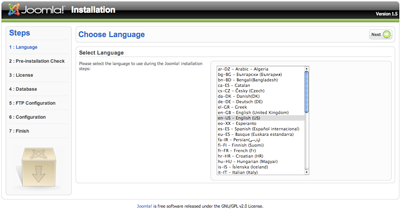
Point your browser to the URL of your site—including any subfolder path if required—where you unpacked all the Joomla files, http://www.example.com/joomla/. You will be taken to the Joomla installation wizard, as shown in the following screen:
On this screen you can select the language for the installation process (there are over 40 to choose from). Click Next and you come to the Pre-Installation Check screen.
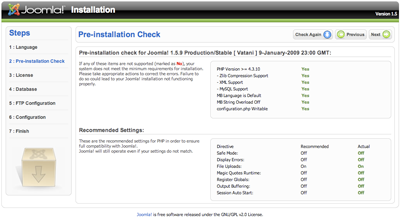
This screen gives you an indication of whether your host has all of the required or desired settings for the Joomla site to run. Assuming all is well, click Next and you will come to the License Information screen. This screen presents you with a copy of the GNU General Public License under which the Joomla source code is released. Peruse at your leisure and click Next. This brings you to the Database Configuration screen.
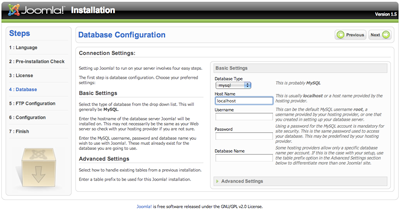
This is probably the most complicated part of the process because you have to know your database credentials for the site to work properly. Often this is done using Plesk, Cpanel, phpMyAdmin, or the command line if you are a true geek. But if you’re unsure you need to ask your hosting service. I’m going to assume that you already know how to create your database and user account:- The database type is likely to be “mysql” (if you know what “mysqli” is then you probably know if you should select it).
- The hostname is likely to be “localhost” but check with your hosting service or IT department.
- The username and password will either have been created by you or given to you by your hosting service.
- The database name is either one you have created, or if the database user account you have has permissions to create a database, then you can enter a new name.
If this is a first-time install, don’t worry about the Advanced Settings slider. It’s only needed if you are installing over the top of an existing database.
Click Next. There might be a short delay while the database scripts are run and, if no errors were encountered, you will be presented with the FTP Configuration screen. Unless you know you’re going to have problems with file permissions (from previous experience), then you can skip past this screen. Joomla’s “FTP Layer” attempts to address some file permission issues but, as stated before, if the host is running PHP in CGI mode, you’re quite safe to omit this step.
Live on the wild side and just click Next; this will bring you to the Main Configuration screen.
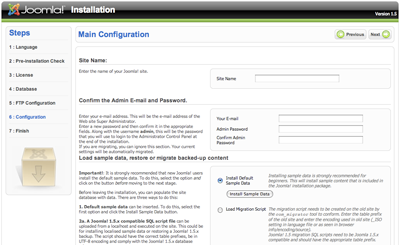
On this screen we set the Site Name and then the Super Administrator email address and password. We can also optionally install some sample data that will produce a fully fledged web site—to give you an example of what you can do—or your can load a migration script from the previous version of Joomla. In this example we’ll bypass loading any sample data because we want a clean site to work with.
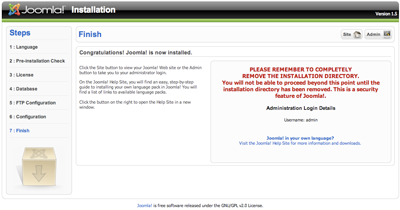
Click Next and you’ll be taken to the Finish screen. Now, I told a lie before. You’ll have to use your FTP Client or File Manager to remove the folder called installation. This is really important because the site will fail to work otherwise. Besides, there are some unscrupulous people out there and, armed with a strong knowledge of Joomla, they could well do some nasty things to your site if you leave it there.
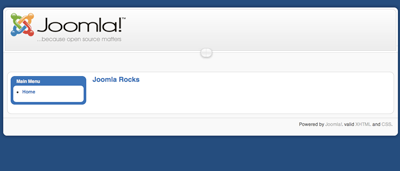
Opting to be lazy and just renaming the folder is unwise—make sure you delete it completely. When you have done that click the Site button. You will be presented with a fairly bland site and a Home link. We need to fix this!
For more information on installing Joomla, see the Joomla Documentation site.
Using Joomla
Well, the entire scope of what you can do with Joomla is far too much for a single article. The Absolute Beginner’s Guide to Joomla is a reference that gently leads you through what you need to know to become a seasoned Joomla master. For now though, we’ll look at how to place a few articles on the site.
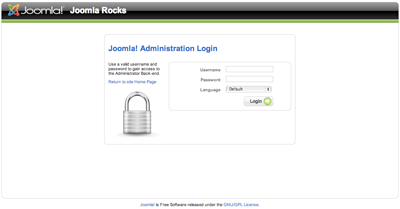
Joomla is one of the few content management systems that completely separates administrative duties from the actual web site that your visitors see. We reach the Administrator by adding “/administrator/” to the URL path in your browser, for example: http://www.example.com/joomla/administator/.
You’ll be asked for a login Username and Password. The Username is “admin” by default and the password is what you set during the installation process. Once you’re in, you’ll see what is called the Control Panel, a screen that will become very familiar to you over time.
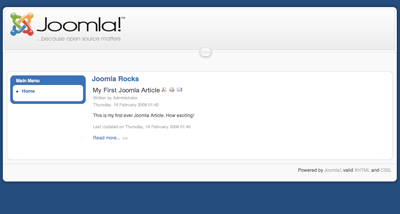
To see the fruits of your labor, click the Preview link that resides just above the Toolbar (or use whatever key or mouse-click combination you need to open it as a new tab).
Viola! You have content.
That’s about all we can cover in this introductory overview. Next time (if they’ll have me back) we’ll look at making the site sizzle with a new template (honestly, the stock one we ship is nice, but really boring) and adding a cool Ajax-driven comments system so that we can start a blog happening.
Useful Links
In the meantime, there are a number of links you absolutely have to know about when beginning your journey into the Joomla-sphere.
www.joomla.org is the main site. The homepage is useful as it aggregates feeds from various locations, and there is some information about the project if you’re interested in that kind of stuff.
community.joomla.org is the hub of the Joomla information universe. It hosts all of the official blogs that come from various working groups in the project, as well as a really cool aggregator of Joomla-related sites (take a look at JoomlaConnect—it will connect you with the highflyers in the Joomla community ).
You'll need to bring your shopping bag to extensions.joomla.org because it's the place where you find out what’s available to add on to Joomla. There are literally thousands of different bits to add—some free, some commercial.
If you really want to be in the mood you can buy a T-shirt, but your main focus will probably be all the books available about Joomla.
Perhaps less exciting than the other sites but useful nonetheless, the documentation wiki site holds a wealth of community-contributed information about using and extending Joomla.
Joomla® is the trademark of Open Source Matters, Inc. in the United States and other countries.
About the author : Andrew Eddie
 Andrew Eddie is the owner of a small web consultancy based near Toowoomba, Australia and co-owner of the product solutions company JXtended which makes several free and commercial extensions for Joomla!, the award winning Content Management System and a project he co-founded. Andrew has been involved in the Open Source Software movement in professional, volunteer and leadership capacities since 2002, and he currently serves as one of the Development Coordinators of Joomla!. He also speaks regularly in Australia and internationally, advocating the cost effectiveness of Open Source software and generally sharing his knowledge about how individuals and business can be empowered by using Joomla!.
Thanks to sitepoint.com
Source : http://www.sitepoint.com/article/introducing-joomla/
Thursday, February 26, 2009
Making Valuable Websites
"Making Valuable Websites By Just Doing What You Do " said Brendon Sinclair in sitepoint tribune.
Websites is like a Jackpot. we cant say 100% sure that the website earn a lot or not.
But, we just aimed thats all. but planning, execution, timing these three terms helps our site growth. we can plan very well and execute that plan with in that particular time period means surely we got success. not only websites in life also.
Many web developers look to affiliate programs and advertising programs (such as Adsense sites) to supplement their incomes.
It's solid thinking -- after all, a web developer has all the skills necessary to promptly launch and market a site using their everyday skills.
I always see two stumbling blocks, though, when it comes to developers trying to establish affiliate sites:
- they expect to make $100,000 per annum for a site
- they're unsure of what affiliate/type of site to develop
My favorite site is one I've owned for four years now. It took me only a couple of hours to develop and generates just a few dollars a day; it will never be a massive earner, but $3 a day over four years is a fantastic return on my time investment. It works out at $1,000+ per hour. That's big money.
The bigger issue for many developers is that they're unclear on what sort of site to develop. Here's what I do: I create sites based on my everyday activities. Because what seems ordinary to you will almost certainly appeal to someone else, who might just want to learn about that specific task or hobby.
I've recently learned how to ride a motorbike -- so I have two sites in that niche now directing traffic to motorbike training businesses.
In May, I'm going off on an 11-day motorbike trip around the Australian island state of Tasmania, and I've already set a site up for the tour. It will be a matter of adding some day-to-day commentary and that site should quickly receive 10-20 visitors a day, generating a couple of dollars a day in ad revenue and affiliate sales.
Having run a lot of marathons over the years, I'm aware that these long distance runners love to see a marathon course in detail before embarking on one. So I've attached a video camera to a bike, ridden the course, and uploaded the resultant video. Thousands of runners in that particular race flocked to my site to check out the course's hills, dips, and potential pitfalls.
Again, a few dollars a day have trickled in.
Whatever you do, document it in words, pictures, and video where possible -- you'll soon have content for a web site that will help you generate income for years to come.
Tuesday, February 24, 2009
More Crimes Against Hypertext - Andrew Tetlaw
The Latest Rogues
The first newcomer to our rogue's gallery comes courtesy of our language editor, Kelly. She was mystified by the separate linking of multiple adjacent words to the same link target, instead of just joining them together into a single link. She called it The Doppelganger.
The next one came from bel, a commenter who said:
Camouflaged for ambush, this link looks like its going to open another web page but instead is actually going to open up a PDF, DOC, email address, etc. Always when you are in a hurry, quickly scanning around for what you are looking for, you click one of these and then BAMM -- you are stuck waiting with your hands tied while it launches your client software. Oh, the howls of chagrin heard from my corner when I’ve stepped on one of these hyperlink land-mines while in a hurry. "Nooooooo! OWWooooooo!!"
I call that one, The Saboteur. Raena, SitePoint's other technical editor, thought this one should be called The Crying Game. I'll leave it to you to ponder that one.
Finally, from another commenter, Wynnefield, is the link called The Mime Artist. This is the link that leaves you wanting "More >>":
It's often taken for granted but the lack of good
hypertext makes reading a web page a generally
unpleasant experience. There are several essential
hyperlinking techniques you should know.
The Mime Artist is so named because it vaguely points in a meaningless direction, gives you no clues as to where it's going, and leaves you wishing you could have your money refunded.
Good Linking Practice
The consensus about good linking practice was that a link should indicate what the user will find when clicking on it. Link text should help the user decide whether or not to follow a link.
Some posters suggested I rewrite the good example to link the intention of the link instead of the name of the target site. So, instead of this:
For excellent examples of finely crafted hypertext
look no further than
kottke.org, the online home of Jason Kottke.
... I'd rewrite the link like this:
For excellent
examples of finely crafted hypertext
look no further than kottke.org, the online home
of Jason Kottke.
Which makes sense to me.
This is supported by the Web Content Accessibility Guidelines 2.0 , that state the purpose of a link should be able to be determined from its link text alone, or the context in which it is placed. In fact, the guidelines describe a failure of accessibility when:
... links such as "click here" or "more" [that] are used as anchor elements, where you need to have the surrounding text to understand their purpose.
So how do we avoid such accessibility problems? Some solutions below....
Solutions
There are many proponents of using the phrase "click here" -- the Tautology link -- as a call to action so that more readers will click on the link. I understand the need for a call to action, so I'd be likely to investigate alternatives before resorting to "click here." For example, you might see:
To see how you can improve your hypertext
today, click here.
I'd first consider changing the language like so:
See how you can improve your
hypertext today!
But if the client demands the "click here" signpost, I'd suggest:
Click here to see how you can
improve your hypertext today!
Regarding the Mime Artist link, if you have to implement a link that uses the word "more" as link text, the guidelines also offer a simple solution (this is echoed on the Max Design web site and many others): Use CSS to hide the portion of the link text you want to keep unseen.
Let's reuse some of the previous markup but add a span that encloses some extra text:
It's often taken for granted but the lack of good
hypertext makes reading a web page a generally
unpleasant experience. There are several essential
hyperlinking techniques you should know.
More about
creating quality hypertext
You then use CSS to move the text within the span element off the screen. The two solutions (linked above) use absolute positioning to move the text, but do it slightly differently from each other. They are worth a look.
The result of either solution is to make only the desired link text visible while making available extended link text for screen readers and search engines.
Wednesday, February 18, 2009
Discussion on web safe fonts
What's the single biggest gripe graphic designers have when it comes to working on the Web?
- variable monitor resolutions?
- perhaps inconsistent color rendering?
- maybe cross-browser quirks?
 Okay, maybe you could present a serious case for the last option -- but in my opinion the number one bugbear is lack of font choice and control.
Most of us come to understand a short list of fonts that are present on most systems, and rarely consider moving outside that list.
The problem is, the font landscape is slowly but constantly changing. Each new version of Office, each new release OS X brings with it a new suitcase of available fonts.
Font Stacks
Although there are plenty of reasons to grumble about the way CSS handles type, it does have a few redeeming features. Font stacks is one of them.
This is where CSS allows us to set a priority list of which fonts are used in each situation. If the designer's most preferred font is absent from the host system, the browser will choose the next listed font, and so on:
font-family:Arial,Helvetica,sans-serif;
In the past, designers have generally played it safe by selecting one of the "big 7" common web fonts first:
- Arial
- Helvetica
- Verdana
- Courier/Courier New
- Times/Times New Roman
- Trebuchet MS
- Tahoma
While this almost guarantees your design looks the same across all platforms, it's certainly a limitation.
What Font?
For the past five years, Codestyle.org have run an ongoing font survey, analyzing the system fonts of visitors to their site. Although the sample group is likely skewed towards the designers and developers that frequent their site, it's arguably still the best information we currently have on font availability in 2009.
Although it's true that the Web's font ecosystem evolves at a glacial pace, sometimes years can pass without us considering what fonts are currently available.
Today I thought we might have a fresh look at the font landscape, and consider some options that might bring freshness to your design without any loss of compatibility.
Palatino Linotype (Win)

At the risk of illiciting a duh from those who use this font often, I'm starting out with Palatino Linotype -- in my view the Web's most under-utilized font.
Why? Well, firstly it has a great pedigree. The original Palatino was a graceful calligraphic serif designed by legendary type designer Hermann Zapf in 1948.
Microsoft then employed Hermann to revise the font for screen usage in the Windows 2000 release, giving us Palatino Linotype. The font has since been included with Office 2003, Office 2007, WinXP, Vista, and presumably Windows 7, making it virtually ubiquitous on the platform.
Palatino Linotype is friendly yet refined, classy but informal in larger type sizes and still reading well down to 12px.
Despite these many and varied attractions, it's still surprisingly little used online. Google reports the text fragment 'font-family:Palatino Linotype' appears 7,750 times, compared to 617,000 for 'font-family:Times New Roman'. Amazing really.
And this despite the fact that CodeStyle now reports Palatino Linotype as far MORE common (97%) than Times New Roman (88%).
Some might argue that both Georgia and Constantia are similar and prettier (but less common), and I'll happily agree and encourage you to list them first in your stack.
Regardless of your number one font choice, I think you would have to question why you'd ever list Times New Roman again. Period.
Century Gothic (Win)

I've always liked the clean geometric lines of Bauhaus design so I have a soft spot for Century Gothic.
Designed as a revival of Sol Hess's 1930s-era Twentieth Century, Century Gothic is a very engineered yet elegant typeface. I've seen it used on everything from cosmetics to horse racing to prestige hotel sites.
 Although I prefer to limit its use to headers, subheaders, and opening paragraphs, it still reads well at 12px -- though it's arguably uncomfortable [KS: or uneasy or awkward] on the eye in large slabs.
Shipping with the last two versions of MS Office, Century Gothic is reported to be present on a respectable 85% of PCs. MS Trebuchet (96%) provides a visually passable fallback on Windows and Futura (90%) provides a good match on Macs.
Nice.
Calibri (Win)

Calibri is, I believe, the best san-serif option of the clutch of new fonts released with Microsoft Vista, Office 2007, and Office 2008 for Mac.
Unfortunately, the less than enthusiastic uptake of Vista has slightly stunted the proliferation of what is a very good screen font. Currently none of the new fonts released with Vista are even a 50/50 chance to be found on any given Windows system. And that's a little sad.
However, if you'd like to own Calibri (or any of its sibling fonts, Candara, Consolas, Cambria, Constantia, and Corbel), they are generally available.
Last time I checked, all of these fonts were freely included with:
- Powerpoint View 2007 for Windows
- Open XML File Format Converter for Mac
Calibri is always described as a humanist font, which I think makes it the kind of font you'd be pleased to take home to meet mother. It's approachable and a bit touchy-feely, and does its best work as body text.
There are two small caveats to using it, however:
- A rendering bug in Firefox 2 caused some of the Vista "C" fonts to disappear at certain sizes. Be sure to thoroughly test your pages in that browser before settling on it.
- Calibri seems to render smaller on the Mac, so be careful using it with layouts that require your text to fill a certain amount of space.
Lucida Grande (Mac)

Okay, so if you're a Mac user, you're likely to be intimately acquainted with Lucida Grande by now and probably rolling your eyes at this recommendation. In fact, you probably see it everywhere you go, from CSS Zen Garden to Facebook.
However, if you're a Windows user who routinely lists Helvetica as "the Mac font" -- and you could do worse -- Lucida Grande is for you.
The original Lucida fonts were designed by Charles Bigelow and Kris Holmes in the mid-eighties. More of an extended font clan than nuclear family, Lucida now contains more than a dozen variants -- including serifs, san-serifs, handwritten, and calligraphic styles, and even mathematics and specialized fax faces.
Lucida Grande is installed with all OS X installations and Code Style reports it present in over 90% of surveyed machines.
The cool aspect for Windows users is that the font comes free with Safari for Windows. All you need to do is locate it in the Safari folder and copy it to the fonts folder:
C:Program FilesSafariSafari.resources
Grande is awful purdy for body text, and it has decent Windows visual equivalents in Calibri (mentioned above), Lucida Unicode, and Trebuchet MS (in that order).
It does seem to render a little smaller on the Mac, so be aware of that when testing. Otherwise, consider giving Helvetica a breather.
Wednesday, February 4, 2009
How To Prevent Data Loss
First, if your site is hosted on a managed server, all but the cheapest of web hosts will provide automated backup services as part of the package. Dreamhost, for example, will back up both the files on your server and your databases on at least a daily basis.

Even Dreamhost, however, is quick to recommend that you also have a backup plan:
"We recommend you always keep your OWN copy of your entire web site at a remote location as well, but we'll do our best to make sure that's never needed."
Keeping your own copy of the code for your site is usually quite easy, since most development is done using such a copy. Code versioning systems like SVN and Git even provide a complete history of that code. The tricky part is keeping a copy of your site's dynamic data, usually in the form of database records.
If your site runs on MySQL, chances are your host provides a copy of phpMyAdmin (or you can set up your own). phpMyAdmin includes an easy-to-use database export feature. On the front page of your phpMyAdmin page, click Export.

Select which database(s) to export, and make sure they're set up to export the data in these database(s) as well as the structure:

Finally, make sure to check the Save as file checkbox and select a compression type, so that the backup is delivered as a file download.

For a small site, that will do the trick. Doing it every single day may be too tedious to be practical, however. That's when it's time to look into some of the automated solutions discussed in the comments thread.
Whichever solution you use, make sure to give some thought to where and how you choose to store your backups. Commenter Tom Rutter has some wise words which I've reproduced below:
"A lot of people's backup strategies take care of some problems, but not all. Ideally, a backup strategy for any data not worth losing needs to be able to cope with:
- Your building burns to the ground
- You find out all your data became corrupted/lost, and you have done backups since
"For the first, you need off-site backup. This ensures that if an entire building is burgled, burned down, flooded, etc then the data is recoverable.
"For the second, you need some sort of history of backups. Incremental backups are good because they allow history but save space, though of course you'll need to think about how easy it is to restore from backup.
"Common backup myth: "RAID is backup"
RAID is not backup. It provides the ability to replace a failed drive without taking down the system, but that is "availability", not backup. For example, it is not intended to protect against either of the two above scenarios. If the building burns down, it's all lost. If data is corrupted, it's all lost (instantly). A faulty disk controller or power supply, or a power surge which your power supply can't cope with, can ruin the entire RAID set. RAID is good if you need high availability, but even if you have RAID you still need backup."
Tuesday, January 27, 2009
sitepoint launches firescope

To coincide with the launch of the redesigned SitePoint Reference web sites, we're very excited to be launching a new browser extension we've developed -- one that puts our reference data right in your test environment.
FireScope is a new add-on for Firebug, the popular web development tool, extending it with reference material for HTML and CSS. Using data directly from our reference sites, the tool provides the most accurate and up-to-date information on usage and browser compatibility, and it's all right there in your browser!
FireScope's core functionality is centered around a new Reference panel, which contains a search tool for looking up HTML elements, attributes, and CSS properties. The tool also hooks into context-menus in the HTML and CSS panels, the DOM crumbtrail, and the Inspector, adding options to look up a selected item (that is, search for it in the Reference panel) or to view a code example. For more information, detailed screenshots, or to download the extension, please visit the FireScope homepage.
About Firescope:
FireScope is a Firefox add-on that integrates with Firebug, to extend it with reference material for HTML and CSS. The extension's core functionality is centered around a new Reference panel, which contains a search tool for looking up HTML elements, attributes, and CSS properties. The extension also hooks into context-menus in the HTML and CSS panels, the DOM crumbtrail, and the Inspector, adding options to look up a selected item (ie. search for it in the Reference panel) or to view a code example.
For getting firescope please click the below link,
https://addons.mozilla.org/en-US/firefox/addon/10273
Tuesday, January 20, 2009
Which URL is Right?
How about starting a crusade to standardize URLs?
http://www.example.com
http://www.example.com/
http://www.example.com/index
http://www.example.com/index.html
http://example.com
http://example.com/
http://example.com/index
http://example.com/index.html
WHICH ONE IS CORRECT??
Good question, Steve! First of all, these pairs are equivalent:
* http://www.example.com
* http://www.example.com/
* http://example.com
* http://example.com/
The trailing '/' is implied if there is no path specified, so you can use either form freely. In the same way, the port number (80) is implied in most URLs, but you could quite correctly spell it out:
* http://www.example.com:80
* http://www.example.com:80/
* http://example.com:80
* http://example.com:80/
Best practice is to leave off the port number when it is 80, of course. As for whether to leave off the path when it is '/', that's a matter of personal preference. Some will argue that leaving off the '/' saves a byte on an Internet crowded with bytes. Others will argue that including the '/' makes it clear to readers that you're referring to the home page of the site in question, as opposed to the site as a whole.
Next we have the question of whether to include a 'www.' at the start of the hostname. This is a rather controversial subject that we covered at length in Tech Times #184. In short, including the 'www.' is a nod to Web tradition, whereas leaving it off is bowing to current Web fashion.
Strictly speaking, neither is correct. Pick whichever suits you best. The important thing is to make sure that the other form automatically redirects to the form you have chosen. If your server answers to both forms without redirection, search engines will see your site as two separate sites (one with the 'www.' and one without), each of which will have a lower search engine ranking than if your site had a single, authoritative hostname.
You can find instructions to set up your web server to redirect to your preferred hostname at the no-www advocacy site. From its name you can tell which URL style it prefers!
As for the URL of the home page (/, /index, or /index.html), again that is largely a matter of personal style, and again the key is to choose one and make sure that the others either redirect to your preferred form, or display a 404 error page. This ensures that search engines don't mistake them for multiple copies of the same page at different addresses.
Click to More...
Wednesday, January 7, 2009
The Principles Of Successful Freelancing

This book contains totally 8 chapters.
Chapter 1: Considering Freelancing?
Chapter 2: Prepare for the Transition
Chapter 3: Manage Your Money
Chapter 4: Set Yourself Up
Chapter 5: Win the Work
Chapter 6: Give Great Service
Chapter 7: Achieve Work–Life Balance
Chapter 8: Where to from Here?
Please click below link to know more about this book :
http://www.sitepoint.com/books/freelancer1/
Subscribe to:
Posts (Atom)
NeoCounter